
















































Finance Minister Unveils Reform Agenda to Spur Growth and Attract Investment
He said beneficiaries were chosen under the programme through a process completely free from political influence.

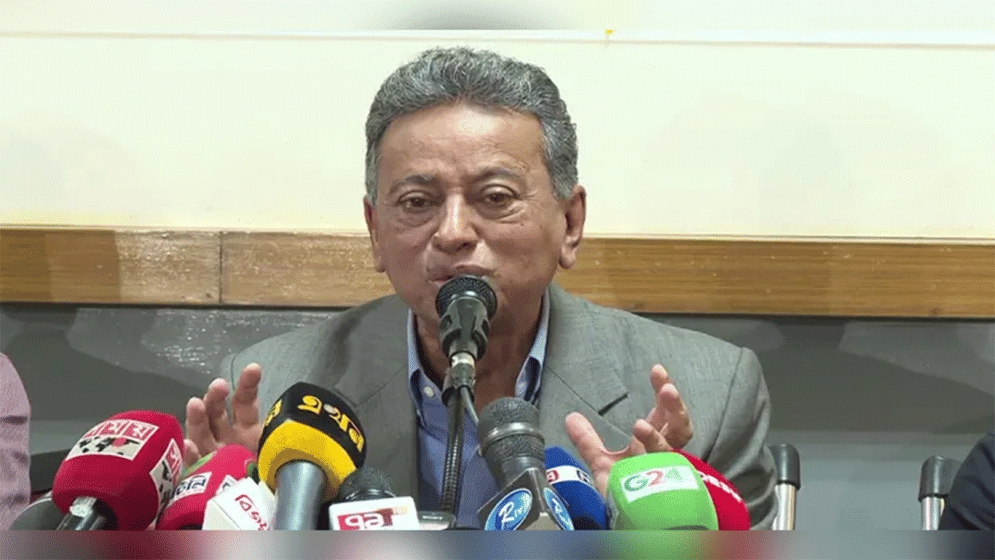
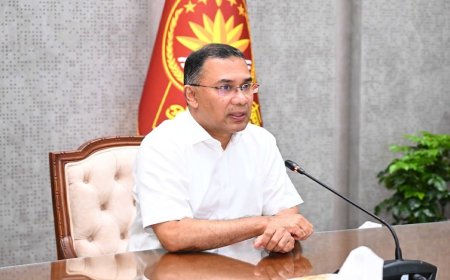
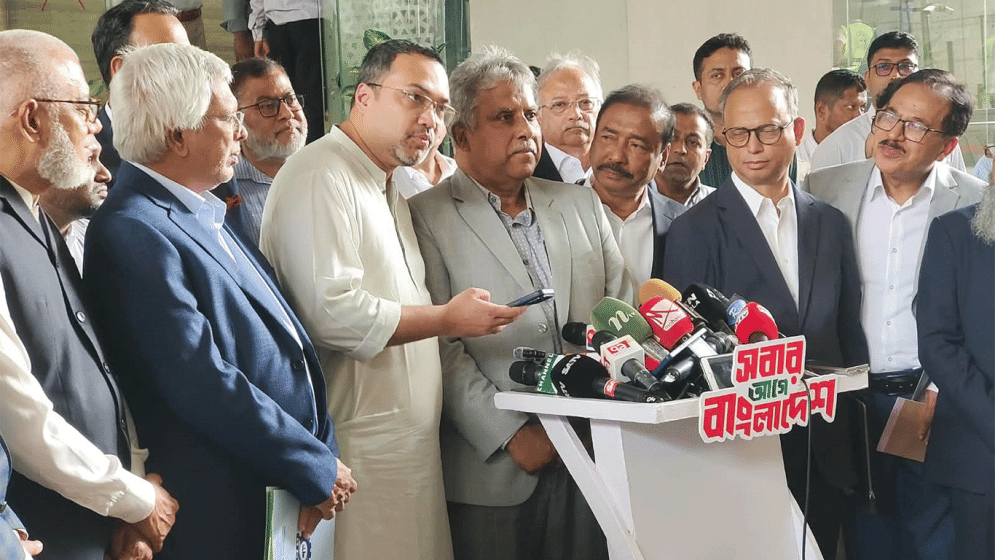
Finance Minister Amir Khosru Mahmud Chowdhury on Sunday laid out a wide-ranging reform agenda focused on strengthening fiscal stability, enhancing governance, expanding social safety nets and promoting private sector-led economic growth as part of the implementation of the national budget.
Speaking as the chief guest at a post-budget discussion organised by the Centre for Policy Dialogue (CPD) at a city hotel, the minister said the FY2026-27 budget had been formulated within a compressed timeframe of about six weeks amid significant fiscal pressures, including nearly Tk50,000 crore in unpaid liabilities in the power sector inherited by the government.
State Minister for Planning Zonayed Abdur Rahim Saki attended the event as special guest, while CPD Fellow Prof Mustafizur Rahman presided over the programme.
Khosru said the government is pursuing a major overhaul of the country's public finance framework by gradually reducing dependence on conventional multilateral lenders and exploring alternative financing options, including bond issuance and market-based funding instruments.
Pointing out that the government is scheduled to repay around Tk1.25 lakh crore in debt during the current fiscal year, he underscored the need for prudent debt management and lower reliance on bank borrowing to free up resources for private-sector investment.
The finance minister highlighted the Family Card programme as a key social protection initiative designed to empower women and ensure transparency in welfare distribution. He said beneficiaries are selected through a process entirely free from political influence, using a Proxy Means Test (PMT) that evaluates household assets and living conditions to identify the most vulnerable families.
To curb leakages and misuse, financial assistance is deposited directly into the accounts of female heads of households, eliminating the role of intermediaries, he added.
Emphasising human capital development, Khosru reiterated the government's commitment to gradually raising spending on education and healthcare to 5 percent of GDP. He noted that a larger share of education funding would be directed towards skill development, vocational training, reskilling and upskilling programmes to better align workforce capabilities with labour market needs and international standards.
The minister also announced a range of incentives for startups, freelancers and content creators to support the country's expanding digital economy.
To improve project implementation, he said a digital monitoring dashboard will be launched on July 1, enabling the Prime Minister's Office and Cabinet Division to monitor development projects on a daily basis. The system is expected to help ensure timely project completion, reduce delays and contain cost overruns.
Khosru further unveiled a broad deregulation initiative aimed at eliminating administrative and regulatory obstacles faced by businesses and citizens. As part of the effort, the government will establish a dedicated website and task force to receive complaints and address regulatory bottlenecks.
On revenue mobilisation, he stressed the importance of expanding the tax net by bringing more professionals—including doctors, lawyers and traders—under the tax system. The goal, he said, is to improve the country's tax-to-GDP ratio through broader participation rather than coercive measures.
To promote export diversification and industrial growth, the minister said duties on industrial raw materials have been reduced, while procedures for accessing duty-free imported inputs through bonded facilities and bank guarantees have been simplified.
Calling on entrepreneurs and investors to seize the opportunities created by the reform agenda, Khosru said the government has established the necessary foundation through deregulation and institutional reforms, and that the private sector must now take the lead in driving economic expansion.
He expressed confidence that coordinated efforts by the government and business community would help Bangladesh realise its long-term ambition of becoming a trillion-dollar economy.
Among those participating in the discussion were National University Vice-Chancellor Prof ASM Amanullah, Bangladesh Chamber of Industries (BCI) President Anwar-Ul-Alam Chowdhury Parvez, Research and Policy Integration for Development (RAPID) Chairman Dr Mohammad A Razzaque, Garments Workers' Trade Union Centre President Montu Ghosh, Bangladesh Garment Manufacturers and Exporters Association (BGMEA) President Mahmud Hasan Khan (Babu), and Power and Participation Research Centre (PPRC) Executive Chairman Dr Hossain Zillur Rahman.
What's Your Reaction?