







































Public Expectations of an Elected Government – Part I: Breaking the Economy Free from Political Entrapment
Public Expectations of an Elected Government – Part I: Breaking the Economy Free from Political Entrapment

Election campaigning for the national parliamentary polls has entered its final and most intense phase. Candidates are criss-crossing the country day and night, making an array of promises to voters. Yet a fundamental question remains largely unaddressed: what do citizens truly expect from an elected government? This is a question political parties must confront with honesty and seriousness.
At the heart of any nation’s progress lies its economy. When the economy falters, the state itself is placed at risk. Without employment opportunities, poverty reduction and a society free from corruption, people cannot live with dignity. Economic security is essential for personal well-being and social stability. However, successive governments have failed to meet even these basic expectations, leading to widespread frustration and a deep sense of disillusionment among the public.
This election is taking place under exceptional circumstances, and expectations of the incoming government are therefore unusually high. Economic recovery must be its foremost priority. Development should not be narrowly defined as infrastructure construction or the rapid enrichment of a politically connected elite. Genuine development means improving living standards for all citizens. Achieving this goal is not the government’s task alone. As in any country, Bangladesh’s economic progress depends on a vibrant private sector, a clean and efficient administration, and people-centred policies anchored in accountability.
Before charting a path forward, the new government must first identify the factors that have weakened the economy in recent years. During the fifteen years of Awami League rule, the economy became synonymous with systemic corruption and plunder. With state patronage, powerful syndicates emerged and gradually tightened their grip across almost every sector. Control of much of the banking system fell into their hands, enabling large-scale loan abuse and capital flight. From power generation to information technology, key sectors were looted under political protection.
Over time, monopolistic control spread throughout the private sector. Business owners and industrialists were compelled to demonstrate loyalty to the ruling party, as operating independently became increasingly difficult. Access to gas connections, investment approvals and basic services was determined more by political alignment than by merit. Vast sums of money were siphoned abroad, while the banking sector slid into disorder, plagued by defaulted loans and institutional decay. Political middlemen thrived on commission-based corruption. Although an image of development was projected internationally, severe structural damage was inflicted domestically. The black economy expanded, and criminal activities such as drug trafficking and arms trading flourished under political shelter. Administrative accountability virtually collapsed.
Public anger over these conditions erupted on 5 August 2024. Following the fall of the Awami League, people hoped for meaningful change and a fresh start. However, over the subsequent seventeen months, the economy continued to move in the wrong direction. The interim government led by Professor Yunus failed to introduce inclusive recovery policies or create a supportive climate for investment.
There were, nevertheless, some positive steps. Efforts to restore discipline in the financial sector—particularly in banking—deserve acknowledgement. The merger of several insolvent banks was an attempt to bring order to a deeply troubled system. Yet persistently high interest rates have fuelled uncertainty and deterred potential investors.
After 5 August, the breakdown of law and order inflicted severe damage on economic activity. Numerous industrial establishments were attacked, with factories looted or set ablaze. Many businesspeople were harassed after being branded associates of the previous government. Extortion through fabricated murder cases created a climate of fear. Bank accounts were frozen indiscriminately, and under the guise of anti-corruption drives, many individuals were subjected to harassment. As a result, businesses shut down and millions lost their livelihoods.
The government failed to restore confidence in the private sector or revive economic momentum. Entrepreneurs remain paralysed by uncertainty. Exports have declined, while investment and job creation have stagnated. The erosion of domestic investor confidence has also discouraged foreign investment. Overall, the economic outlook remains bleak. Remittances continue to provide the only major relief, yet even labour exports have become more difficult. Several countries have restricted access for Bangladeshi workers, while little progress has been made in developing skilled manpower. Although some action was taken against fraud in manpower exports, the issuance of more than two hundred new licences on political grounds merely shifted control from one syndicate to another.
Despite limited efforts to curb money laundering, there has been no meaningful success in recovering funds already sent abroad. Ordinary citizens are bearing the burden. Inflation has driven up the cost of living, making daily survival increasingly challenging. It is against this grim backdrop that the new government will assume office, and from day one it must confront the economic crisis and dispel uncertainty.
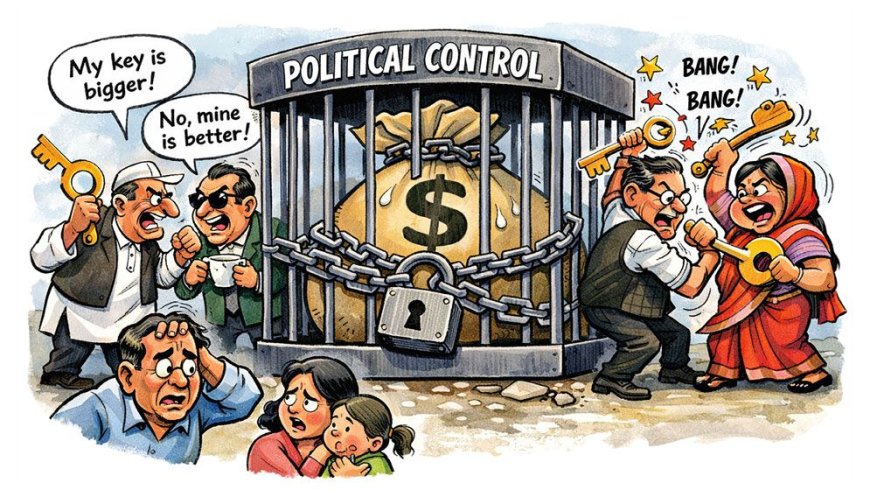
Whoever forms the next government must act swiftly to revive the economy. Rebuilding confidence in the private sector must be a top priority. Businesses should be evaluated not by political identity or past affiliations, but by their contribution to national growth. The practice of dividing entrepreneurs into “ours” and “theirs” must end, and economic activity must be freed from political control immediately.
Restoring law and order is equally critical. Security and stability are prerequisites for development. Without them, neither domestic nor foreign investors will commit resources. Continued violence and extortion will drive even existing businesses away, making it imperative for the government to protect life and property.
Corruption must be addressed decisively. Past experience shows that each new administration tends to nurture its own corrupt network. The next government must target genuine offenders rather than using anti-corruption campaigns as tools against political opponents. Economic progress is impossible without curbing corruption.
Recovering stolen assets is another vital task. Transparent and effective measures must be taken to retrieve funds laundered abroad over the past fifteen years or more. This issue must not be politicised but handled with resolve and integrity.
Financial institutions must also be insulated from political interference. In the past, banks were controlled by those in power, with licences and board positions awarded on partisan grounds. Loans approved for political reasons have largely turned into bad debts. This culture must end.
An investment-friendly environment must be created. Doing business in Bangladesh remains unnecessarily difficult due to bureaucratic complexity, prolonged approval processes and hidden costs. High interest rates, along with harassment in securing gas and electricity connections, further discourage investors. These barriers must be removed, and a genuine one-stop service established to ease business operations.
Small and medium enterprises, which are crucial to employment and growth, require targeted support to expand and thrive. The administration itself must become business-friendly, dismantling excessive red tape that stifles initiative and innovation.
Greater support should also be extended to women entrepreneurs. With appropriate training and assistance, their growing participation can make a substantial contribution to the economy.
Finally, export diversification is essential. Bangladesh’s heavy reliance on the garment sector is risky. Other sectors—such as agriculture, pharmaceuticals and leather goods—hold significant export potential. With proper support, they could generate valuable foreign exchange and reduce dependence on a single industry.
If these measures are implemented with sincerity, the economy can be revitalised. Employment will grow, poverty will decline, inflation will ease and Bangladesh can move forward with renewed confidence and stability.
What's Your Reaction?