


























































Mega Budget Faces Eight Key Challenges
Mega Budget Faces Eight Key Challenges

The government is set to unveil the largest national budget in Bangladesh’s history, but economists caution that the ambitious spending plan faces significant fiscal constraints and may offer limited relief to millions of citizens grappling with persistently high living costs.
The BNP-led coalition government under Prime Minister Tarique Rahman is expected to place a budget of nearly Tk9.38 lakh crore for fiscal year 2026–27 (FY27) before parliament tomorrow. The proposed outlay is around Tk1.48 lakh crore higher than the original allocation of Tk7.90 lakh crore for the current fiscal year.
However, the government has projected revenue earnings of only Tk6.95 lakh crore, leaving a budget deficit of approximately Tk2.43 lakh crore.
With revenue collection continuing to lag behind targets, economists believe the government will have to rely heavily on both domestic and external borrowing to finance the gap.
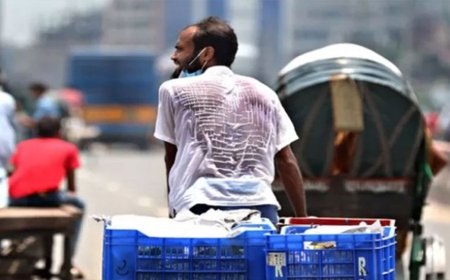
Inflation remains above 9%, placing considerable strain on an estimated 40 to 50 million low- and fixed-income people. Rising prices of essential commodities, including rice, lentils, edible oil, gas and electricity, have significantly increased household expenses.
Dr Mustafa K Mujeri, former chief economist of Bangladesh Bank, questioned the rationale behind such a large expenditure programme under prevailing economic conditions.
“The key question is whether such a large budget is necessary at this moment, as revenue mobilisation cannot be increased overnight,” he told the Daily Sun.
Highlighting the structural imbalance in public finances, he said, “While the size of the budget continues to expand, revenue generation is not growing at the same pace. Consequently, the economy is becoming increasingly dependent on borrowing. At the same time, rising administrative expenditures and higher salaries and allowances for public servants are adding further pressure.”
Zahid Hossain, former lead economist at the World Bank’s Dhaka office, argued that controlling inflation should be the foremost objective of the upcoming budget.
“Containing inflation is essential for preserving macroeconomic stability. Most government decisions at present are driven by expenditure. The economy is facing both an energy crisis and uncertainty in agricultural production. Together, these factors are creating a combination of high inflation and sluggish growth, increasing the risk of economic stagnation and limiting employment opportunities,” he said.
He also stressed the importance of securing financing before expanding expenditure, warning that otherwise debt obligations and interest payments could rise rapidly and create repayment risks in the future.
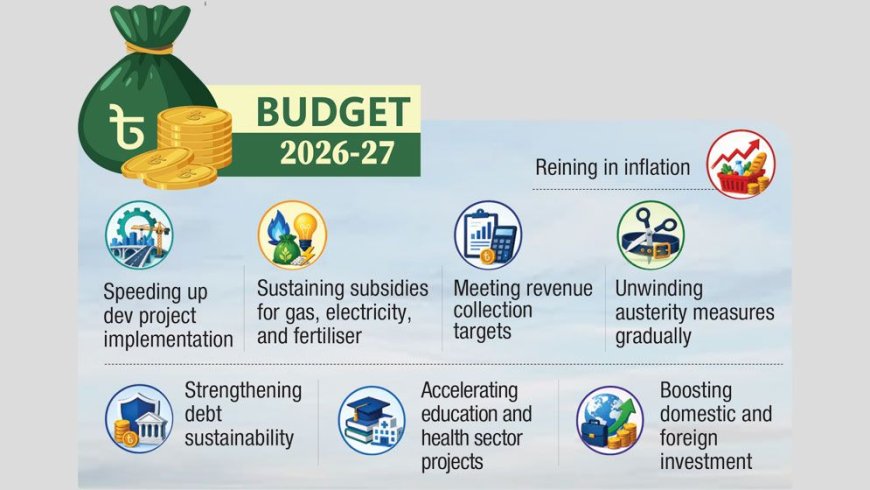
Eight challenges for the mega budget
Economists have identified eight major challenges that could determine the success of the proposed budget.
1. Containing inflation: Inflation reached 9.42% in May. Although the government aims to bring it down to 7.5% in FY27, analysts believe achieving that target will be difficult under current market conditions.
2. Achieving the revenue target: The government plans to collect Tk6.95 lakh crore in revenue. Yet the shortfall during the first ten months of FY26 stood at Tk1.04 lakh crore and is expected to rise to around Tk1.5 lakh crore by the end of the fiscal year.
3. Managing the exit from austerity: Gradually easing austerity measures without undermining economic stability will require careful policy coordination.
4. Meeting subsidy demands: Rising subsidy requirements for gas, electricity and fertiliser must be balanced against the need to maintain development spending under the Annual Development Programme (ADP).
5. Improving project implementation: Persistent bureaucratic delays and structural inefficiencies continue to increase project costs and slow the delivery of infrastructure and social-sector initiatives.
6. Strengthening education and health spending: Implementation of projects in the education and health sectors remains slow, while approvals of foreign-funded projects have declined considerably.
7. Reviving investment: High borrowing costs, energy shortages, exchange-rate volatility and policy uncertainty have weakened investor confidence, affecting both local and foreign investment.
8. Balancing competing pressures: Successfully addressing all of these challenges simultaneously, without allowing one problem to aggravate another, may prove to be the government’s most difficult task.
What's Your Reaction?