

































































Half of banks fall short amid rising default loans
Half of banks fall short amid rising default loans

The persistent rise in non-performing loans (NPLs) has significantly weakened Bangladesh’s banking sector, with half of the country’s domestic banks failing to meet mandatory provisioning requirements against defaulted loans.
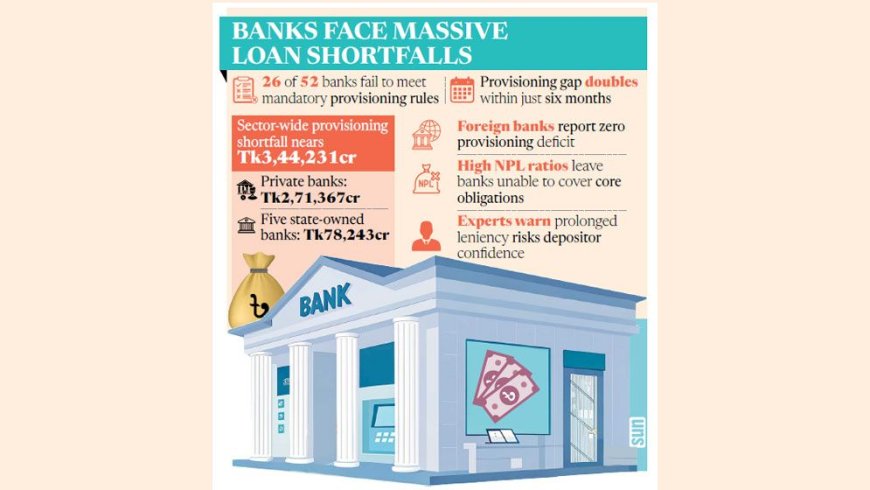
Bangladesh Bank data show that 26 of the 52 domestic lenders did not maintain the required loan-loss provisions, resulting in a combined provisioning shortfall of nearly Tk344,231 crore across the sector.
The strain has intensified sharply, with the overall gap doubling within just six months. State-owned banks, along with several private and Shariah-based lenders carrying heavy NPL burdens, have been the primary contributors to the widening deficit.
Mustafa K Mujeri, former chief economist of Bangladesh Bank, said banks with elevated NPL ratios are now under severe pressure.
“Banks with higher NPL ratios are particularly vulnerable, as their operating income is no longer sufficient to simultaneously meet three key obligations—paying interest to depositors, covering operating expenses, and maintaining mandatory provisions,” he said.
Mujeri attributed the growing shortfall to weak recovery of defaulted loans, prolonged regulatory leniency towards large borrowers, and the long-standing practice of repeated loan rescheduling and write-offs.
“If this trend continues, depositor confidence will inevitably erode, posing a serious threat to financial stability,” he warned.
Under existing regulations, banks are required to maintain provisions ranging from 0.25% to 5% for unclassified loans. Sub-standard loans require a 20% provision, doubtful loans 50%, and bad or loss loans 100%.
Despite the steady increase in defaulted loans over the years, many banks have failed to raise provisions in line with regulatory requirements, often relying on accounting adjustments and regulatory forbearance to limit reported losses.
Central bank figures show that by the end of the September quarter of the current year, five state-owned banks, 20 private banks, and one specialised bank fell short of required provisioning levels. Their combined deficit stood at Tk349,869 crore.
After adjusting for surplus provisions held by some lenders, the net provisioning shortfall across the banking sector amounted to Tk344,231 crore.
Private banks accounted for the largest share of the deficit, with 20 lenders posting a combined shortfall of Tk271,367 crore. Five state-owned banks followed with Tk78,243 crore, while one specialised bank recorded a gap of Tk259 crore.
In contrast, none of the nine foreign banks operating in Bangladesh reported any provisioning shortfall during the period.
Banks with unusually high shortfalls
As of the September quarter, several banks across state-owned, private, and Shariah-based segments reported exceptionally high provisioning deficits. The list includes at least five lenders allegedly affected by large-scale loan siphoning linked to the S Alam Group.
Islami Bank Bangladesh recorded the largest shortfall at around Tk82,094 crore, followed by the merged First Security Islami Bank with Tk52,569 crore. State-owned Janata Bank ranked third, with a deficit of Tk48,031 crore.
Other major shortfalls were reported by the merged EXIM Bank (Tk23,548 crore), Social Islami Bank (Tk21,386 crore), Union Bank (Tk15,256 crore), and Global Islami Bank (Tk8,881 crore).
Among conventional banks, National Bank posted a deficit of Tk24,282 crore, IFIC Bank Tk19,050 crore, Rupali Bank Tk13,073 crore, Agrani Bank Tk11,705 crore, and Premier Bank Tk10,048 crore.
Additional banks with provisioning gaps include BASIC Bank (Tk5,393 crore), UCB (Tk4,306 crore), Standard Bank (Tk2,565 crore), Mercantile Bank (Tk1,672 crore), NRBC Bank (Tk1,555 crore), AB Bank (Tk1,490 crore), Southeast Bank (Tk1,125 crore), Dhaka Bank (Tk636 crore), Bangladesh Commerce Bank (Tk615 crore), NRB Bank (Tk270 crore), Probashi Kallyan Bank (Tk239 crore), Bangladesh Development Bank (Tk40.35 crore), ICB Islamic Bank (Tk7.43 crore), and NCC Bank (Tk7.24 crore).
NPLs surge after regulatory tightening
The growing provisioning shortfall coincides with a sharp rise in reported NPLs following changes in loan classification rules.
Under the previous Awami League government, several borrower groups allegedly diverted funds through loans taken under multiple identities, often benefiting from regulatory concessions that kept NPL figures artificially low.
By the end of September last year, total NPLs stood at Tk644,515 crore, accounting for 35.73% of outstanding loans.
Following the change in government, Bangladesh Bank aligned loan classification rules with international standards, triggering a rapid increase in reported NPLs over recent quarters.
What's Your Reaction?