








































































Global growth threatened by energy shocks, rising debt and AI risks
Global growth threatened by energy shocks, rising debt and AI risks


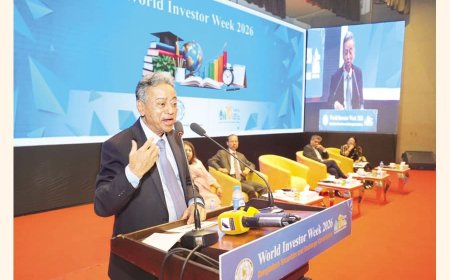
The global economy faces growing risks from persistently high energy prices, record public debt and the rapid expansion of artificial intelligence investment, IMF Managing Director Kristalina Georgieva warned on Wednesday, calling on governments to strengthen fiscal and monetary safeguards.
Speaking ahead of next week’s IMF and World Bank Annual Meetings in Bangkok, Georgieva said the global economy was being pulled in opposite directions by two major shocks: a negative energy supply shock stemming from conflicts in the Middle East and a positive demand shock driven by AI investment, which is also contributing to inflation.
“The combined impact of these two forces is highly uneven across the world,” Georgieva said, noting that many countries were being left out of the AI boom. She said the IMF’s updated growth forecasts, to be released during the Bangkok meetings, would show the largest downgrades in economies hit hardest by war, including Ukraine and Gulf states affected by Iranian strikes and falling energy exports.
Georgieva did not say whether the IMF would revise its July forecast for global growth of 3.0% in 2026. The fund had projected growth would accelerate to 3.4% in 2027, based on an assumption that shipping through the Strait of Hormuz would gradually return to normal by March 2027.
That earlier outlook was based on average oil prices of $89 a barrel in 2026 and $78 in 2027. However, Georgieva said oil prices have remained around $100 a barrel, while disruptions to refining capacity have added another $100 per barrel in refining margins for products such as diesel.
She also warned that winter heating demand could push energy pressures higher as natural gas supplies remain constrained by threats to LNG shipments through the Strait of Hormuz.
“Even if the war in the Gulf were to end soon, the problem of high energy prices will likely persist for some time,” Georgieva said, pointing to Brent crude futures that indicate elevated oil prices could continue through 2027.
Higher energy costs are feeding into inflation, interest rates and government bond yields, she said. Yields on 10-year US, German and Japanese government bonds have reached their highest levels since 2007, 2009 and 1996, respectively, and remain on an upward trend.
Rising public debt is another major concern for policymakers, Georgieva said, warning that heavy debt burdens are weakening growth while adding to inflationary pressures. The IMF estimates global public debt is at its highest level since World War Two and could surpass 100% of global GDP before 2030.
She identified advanced economies, particularly the United States, as having some of the heaviest debt burdens, with debt-to-GDP ratios exceeding those of emerging and low-income economies.
Georgieva said governments could no longer depend solely on faster economic growth to address their fiscal challenges. High-debt advanced economies need credible medium-term plans to reduce deficits, supported where necessary by immediate fiscal measures that could also ease pressure on central banks.
She also warned that inflationary pressures remain elevated after more than five years of above-target inflation, citing the AI investment boom, energy and food shocks, tariffs, increased defence spending and rising debt-servicing costs.
“A prudently hawkish bias” in monetary policy may now be appropriate in many countries, Georgieva said, describing recent rate decisions by the US Federal Reserve, the European Central Bank and the Bank of Japan as appropriate.
During a discussion after her speech, she said central banks’ key priority should remain price stability and that policymakers must clearly demonstrate their commitment to controlling inflation.
Georgieva stressed that this requires independent central banks capable of resisting pressure from governments to ease fiscal strains by purchasing debt or otherwise loosening monetary policy.
She also pointed to significant risks associated with the AI investment boom. AI-related spending as a share of GDP could surpass investment levels seen during the development of railways, electricity grids and telecommunications infrastructure.
The growing concentration of economic and financial resources in AI companies is increasing pressure on them to deliver productivity and earnings gains that justify high valuations, she said. Any major market disappointment could trigger a broader economic and financial shock.
At the same time, Georgieva said IMF research indicates that AI could boost global economic growth by around half a percentage point annually if developed and deployed effectively.
She stressed the importance of AI preparedness, including regulatory safeguards to address potential risks such as large-scale job losses, cyber threats, financial instability and the possibility of advanced AI systems escaping meaningful human control.
Beyond strengthening public finances, Georgieva urged governments to pursue structural reforms to support growth. These include improving workforce skills, making it easier to start and close businesses, strengthening energy security and reducing unnecessary regulatory barriers.
What's Your Reaction?