
























































Cox’s Bazar Tourism Boom Highlights Gaps in Visitor Safety
Cox’s Bazar Tourism Boom Highlights Gaps in Visitor Safety

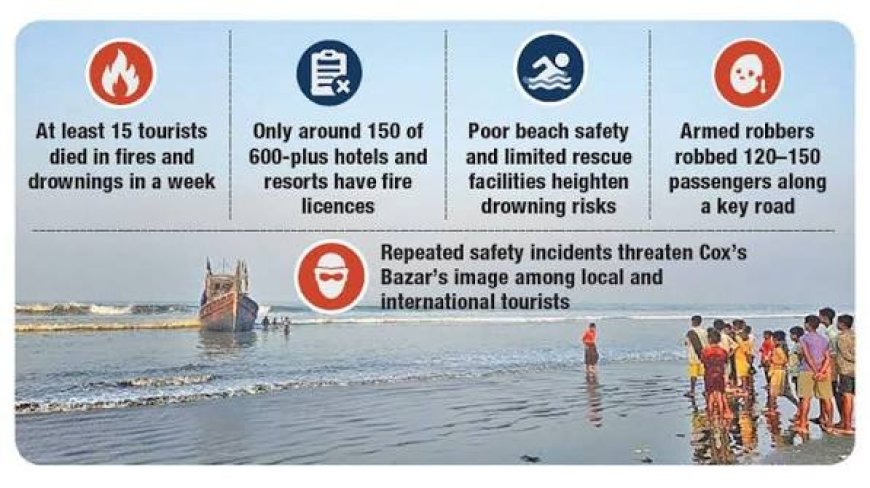
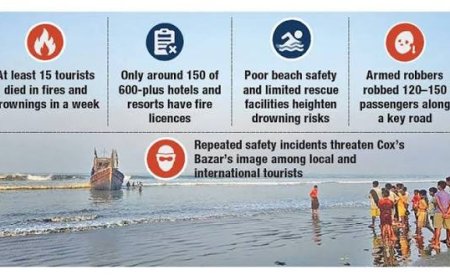
Cox’s Bazar’s growing popularity as a tourist destination is being overshadowed by a series of deadly accidents and security incidents, raising serious concerns over visitor safety amid inadequate fire protection, drowning risks and armed robberies. At least 15 tourists have died in fires and drowning incidents over the past week, as hundreds of thousands of holidaymakers flocked to the country’s premier seaside destination during the extended Durga Puja holidays and weekends.
A deadly resort fire, the drowning of five holidaymakers at Himchhari beach and reports of armed gangs robbing dozens of vehicles have intensified concerns over whether safety measures are keeping pace with the growing influx of tourists at the start of the peak travel season.
The concerns deepened on Friday when another fire broke out at The Sea Princess Hotel in Cox’s Bazar, triggering panic among around 300 tourists and prompting a rush to escape.
The incident came less than a week after a fire at Tuptup Resto & Resort in the Patuartek area near Inani Beach killed 10 people on 17 October. The three-storey wooden establishment was operating without a fire safety licence, despite being identified as hazardous by the Fire Service and Civil Defence in June.
The incidents have triggered widespread criticism of shortcomings in the district’s tourism sector, particularly the lack of effective safety enforcement and emergency preparedness.
Sharmin Jahan Tonni, a housewife from Uttara in the capital, visited Cox’s Bazar with her husband and six-year-old daughter shortly after the resort fire.
Visiting the beach for the first time, she said the trip had left her with mixed feelings.
“Besides being mesmerised by the natural beauty, including sunsets over the sea, the beach and the crowds, the trip also left me feeling anxious. I was afraid that accidents could happen on the roads. I was also worried about whether a fire might break out at the hotel where I was staying, as there could be a restaurant on the ground floor,” she said.
Hotels and resorts operating without approval
Marine Drive in Cox’s Bazar is lined with restaurants and resorts, with many more under construction. However, the administration does not have an accurate count of the district’s hotels and resorts, estimated at between 500 and 600, many of which reportedly operate without the necessary approvals and fire safety licences.
“Some 40 to 50 resorts had been built around Marine Drive without approval. Our association has around 250 registered hotel and resort members,” Mukim Khan, general secretary of the Cox’s Bazar Marine Drive Hotel and Resort Owners Association, told the Daily Sun.
The lack of regulatory compliance came under renewed scrutiny following the fire at Tuptup Resto & Resort, which killed 10 tourists, including women and children.
Cox’s Bazar Development Authority (CDA) Chairman Engineer Jasim Uddin said the authority had issued three notices to the resort since 2023, culminating in a final order to remove the structure. He added that CDA approval was mandatory for all buildings, but most hotels and resorts in Cox’s Bazar had been constructed without it.
“We are preparing to conduct drives in coordination with the administration,” he said.
Fire Service officials said most of the district’s more than 600 hotels and resorts lacked fire safety licences, with only around 150 having the required permits.
Inspector Shafiqul Islam said about 125 manual licences had been issued or renewed in previous years, while 23 of 53 applications for electronic licences had been approved. The Fire Service had also issued notices to around 500 establishments.
“We urge them to obtain fire licences. Anyone running a business must ensure safety. Fires can happen, but our primary goal is to ensure that people’s lives are not put at risk and nobody dies,” he said.
Shafiqul added that the Fire Service could raise awareness and issue warnings but faced limitations in enforcing compliance.
“We can only raise awareness and issue warnings,” he said, explaining that officials could not initiate mobile court operations solely after issuing notices because the department did not have its own magistrates or the authority to seal premises.
Inadequate beach safety raises drowning risks
Safety concerns extend beyond hotels and resorts to the district’s beaches, where insufficient rescue facilities, inadequate warning signs, untrained lifeguards and weak monitoring of dangerous areas continue to put visitors at risk.
Despite significant infrastructure development, the absence of clearly designated safe swimming zones and effective safety systems remains a major concern for tourism operators and other stakeholders.
Sea-Safe Lifeguard supervisor Sifat Saifullah said shifting sand and underwater channels along the 120-kilometre coastline posed serious risks to tourists unfamiliar with local conditions.
He said many visitors continued to disregard lifeguards’ red flags and public warnings.
Local residents said the existing workforce of 25 lifeguards, 25 beach workers and around 70 to 80 tourist police personnel was insufficient to manage the vast beach, particularly during peak holiday periods.
Anwar Kamal, president of the Tour Operators Association of Cox’s Bazar (TOAC), said safety personnel were doing their best despite limited resources.
“Safety workers try their best with their limited resources. But they lose control over the situation whenever the number of tourists increases during special occasions,” he said.
Armed robberies expose security weaknesses
A series of armed robberies has further heightened concerns over the safety of tourists and other travellers using roads in and around Cox’s Bazar.
On Monday, passengers travelling along the Eidgaon-Eidgarh-Baishari road were reportedly targeted twice by robbers at Himchhari Dhala, once in the morning and again in the afternoon.
According to victims, eight to 12 masked and armed men blocked vehicles, held passengers hostage and took some of them to a nearby forest, where they were beaten and robbed.
The gang reportedly stopped around 50 auto-rickshaws and motorcycles, robbing an estimated 120 to 150 passengers.
Passengers alleged that no police patrol was present despite the robberies continuing for several hours.
Abdul Hakim, an accountant at a private organisation’s Eidgarh branch, said armed robbers intercepted his CNG-run auto-rickshaw while he was travelling from Eidgaon to Eidgarh with two other passengers.
He alleged that the attackers held them at gunpoint and snatched Tk1.5 lakh in cash and a bank cheque book. He added that robberies were frequent on the route.
Eidgaon Police Station Officer-in-Charge ATM Sifatul Mazdar said several police teams were conducting raids to arrest those involved and that patrols had been intensified in the area. Two people had also been detained for questioning in connection with the incident.
Cox’s Bazar Superintendent of Police ANM Sajedur Rahman said district police and tourist police were working regularly to ensure the safety of travellers and local residents.
Tourism industry faces growing pressure to act
The recent incidents have raised questions about whether the authorities are doing enough to protect visitors as Cox’s Bazar prepares for its busiest tourism period.
Abu Morshed Chowdhury, president of Cox’s Bazar Nagorik Samaj, warned that failure to ensure tourist safety could discourage holidaymakers and damage the destination’s reputation among both domestic and international visitors.
“A series of incidents of fires, drowning and robberies has raised public concern. Alongside taking action against criminals, safety must be ensured at hotels, the beach and tourist spots and security must be strengthened at key access roads,” he said.
The mounting concerns point to the need for stronger enforcement of building and fire safety regulations, better-equipped beach rescue services, more effective monitoring of dangerous swimming areas and increased security patrols on vulnerable roads.
For Cox’s Bazar, the challenge is no longer simply managing its growing popularity but ensuring that the millions of people drawn to its beaches and resorts can enjoy their holidays without being exposed to preventable risks.
What's Your Reaction?