


























































Exports rise 6.34% to $13 billion in July–September
September export earnings climb 8.54%, seen as a positive signal by exporters

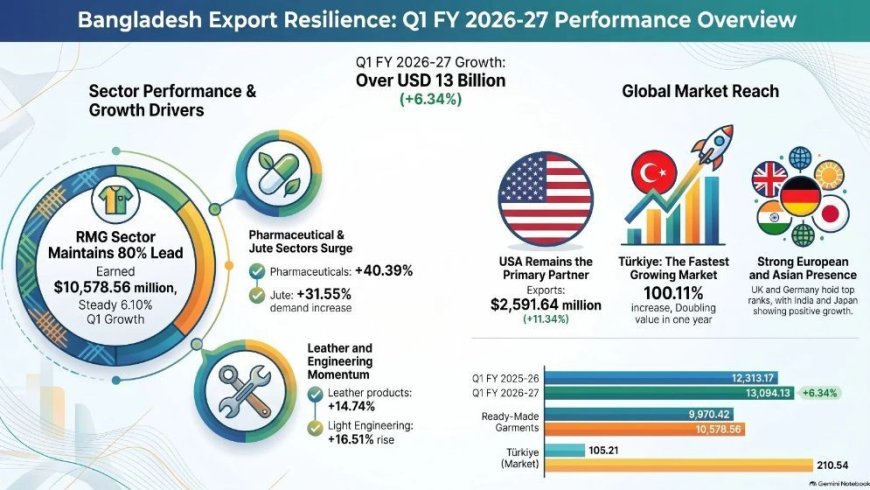
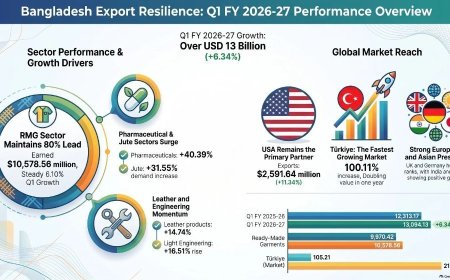
Bangladesh’s merchandise exports rose 6.34% year-on-year to US$13.09 billion in the first quarter of fiscal year 2026-27, compared with $12.31 billion in the same period a year earlier, according to Export Promotion Bureau (EPB) data released on Thursday.
Export earnings also registered robust growth in September, increasing 8.54% to $3.94 billion from $3.63 billion in September 2025.
The ready-made garment (RMG) industry, the country’s largest export-earning sector, continued its upward trend throughout the July-September quarter.
RMG exports climbed 6.10% to $10.58 billion during the first three months of FY27, up from $9.97 billion in the corresponding period last year.
In September, garment exports rose 8.56% year-on-year to approximately $3 billion from $2.84 billion.
Knitwear exports grew 6.88% during July-September to $5.96 billion, compared with $5.58 billion a year earlier. Woven garment exports increased 5.11% to $4.61 billion from $4.39 billion.
EPB figures showed that knitwear and woven garment exports recorded year-on-year growth of 8.58% and 8.54%, respectively, in September.
Several key non-RMG industries also registered notable growth during the quarter.
Leather and leather goods exports increased 14.74% in July-September, while September earnings surged 20.19% year-on-year.
Jute and jute goods exports expanded 31.55% during the first quarter, with September recording a 22.72% annual increase.
Light engineering exports rose 16.51% during July-September, although September growth stood at 3.76%.
Home textile exports increased 11.94% in the first quarter and 13.52% year-on-year in September.
Pharmaceutical exports registered particularly strong performance, surging 40.39% during July-September and 64.33% in September compared with the same month last year.
However, agricultural products and frozen and live fish experienced negative growth during the period.
The United States continued to be Bangladesh’s largest export market, with shipments rising 11.34% to $2.59 billion in July-September from $2.33 billion in the corresponding period of FY26.
The United Kingdom retained its position as the second-largest destination, importing $1.37 billion worth of Bangladeshi products, followed by Germany at $1.23 billion.
Türkiye recorded the highest growth among major export destinations, with shipments more than doubling by 100.11% to $210.54 million from $105.21 million.
India and Japan ranked sixth and ninth, respectively, among Bangladesh’s leading export markets, with both registering positive growth.
The EPB said the latest figures demonstrated the resilience of Bangladesh’s export industry and continued demand from global buyers.
The agency said it would pursue further initiatives in export diversification, market expansion, product upgrading and trade facilitation to maintain momentum and meet the country’s long-term export targets.
‘A positive sign’
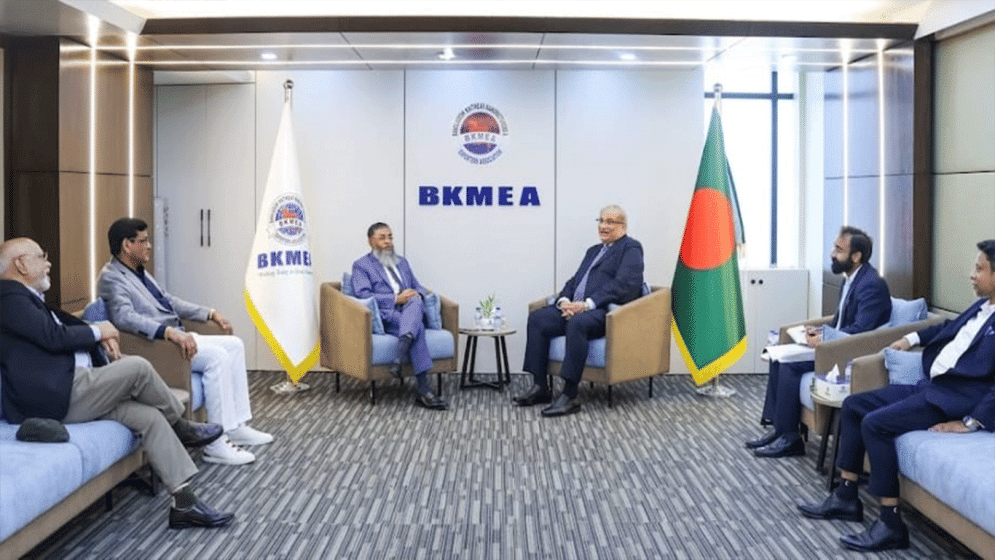
Bangladesh Knitwear Manufacturers and Exporters Association (BKMEA) Executive President Fazlee Shamim Ehsan termed September’s export performance encouraging, despite the fuel crisis that disrupted factory operations throughout August.
“Despite most factories struggling with the crisis, it is possible that this growth was driven by some factories that managed to achieve exceptionally high export volumes through their own efficiency and capabilities,” he said.
Former Bangladesh Garment Manufacturers and Exporters Association (BGMEA) director Mohiuddin Rubel also welcomed the continued improvement in export performance.
“It is encouraging that exports grew for the second month in a row, and both knit and woven are up. But much of September’s 8.56% growth comes from a low base, as September 2025 was a weak month at $2.84 billion,” he said.
Rubel noted that cumulative RMG export growth rose to 6.10% at the end of September from 5.12% at the end of August, as September’s performance exceeded the July-August average and helped compensate for July’s decline.
“The trend is positive, but we need to keep it going and build on it to reach the target,” he added.
What's Your Reaction?