































































‘This is our culture’: Japan fans tidy up World Cup stadium after match
‘This is our culture’: Japan fans tidy up World Cup stadium after match

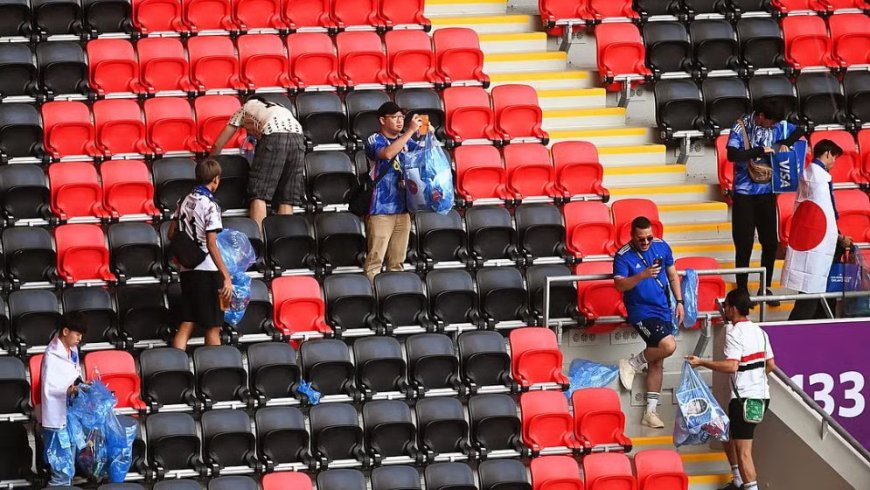
Japan supporters left the stands spotless after their World Cup opener against the Netherlands in Texas on Sunday, saying that cleaning up after themselves is simply part of Japanese culture.
Following the 2-2 draw, fans remained in the stadium to collect litter, carefully gathering rubbish into blue plastic bags and ensuring the venue was left as clean as they had found it.
The practice, they said, is rooted in habits learned from an early age. “We have to think about everyone,” said 20-year-old supporter Eita Tanaka, dressed in Japan’s blue jersey and holding a beer and several cups.
“In Japan, we are taught that when we use a place, we should leave it tidier than it was when we arrived,” he explained. “At school, we clean our classrooms ourselves without being told by teachers.”
Competing in their eighth consecutive World Cup, Japan have become well known internationally for the cleanliness and discipline of their supporters.
Even former NFL quarterback Jameis Winston joined the effort after Sunday’s match, helping collect rubbish while wearing a Japan shirt bearing his name.
Another fan, Futo Hagiwara, said he was proud that the behaviour of Japanese supporters had gained global recognition.
“This is our culture,” he said. “Wherever we go, we clean up after ourselves. It reflects our values and attitude.”
Experts say the phenomenon stems from a combination of social responsibility and group expectations. Sociologist and philosopher Masachi Ohsawa noted that while Japanese people may not always focus on large-scale issues such as global inequality or climate change, they are highly conscious of how their actions affect those around them.
“When sharing a space with others, people feel a strong responsibility not to inconvenience or discomfort anyone,” he said.
A Lesson Learned Early
Cleaning is deeply embedded in Japanese education. Schoolchildren routinely sweep floors, wipe desks and clean classrooms as part of their daily routine.
Public rubbish bins are also relatively uncommon across Japan, with people generally expected to take their waste home. Household garbage disposal often requires strict sorting into multiple categories.
Scott North, an emeritus sociology professor at the University of Osaka who has lived in Japan for nearly four decades, said community clean-up activities are common.
“My neighbours and I get together twice a year to pull weeds and collect garden waste,” he said, noting that such activities are often organised around group participation and leadership.
“When everyone is involved, there is an expectation that people will contribute. If organisers hand out rubbish bags, very few people will refuse.”
Ohsawa added that the Japanese concept of “reading the air” — understanding and responding to social expectations — also plays a role.
“If one person starts picking up litter, others feel compelled to join,” he said. “People do not want to be viewed negatively by those around them.”
According to Ohsawa, peer pressure can be a powerful motivator. In many cases, the desire to avoid being seen as a nuisance within one’s group may outweigh concerns about the cleanliness of the venue itself.
Regardless of the motivation, Japan’s supporters intend to continue the tradition throughout the tournament.
With Japan set to face Tunisia in Mexico on Saturday, Hagiwara said fans would keep leading by example.
“We usually don’t tell children what they should do,” he said. “We simply show it through our actions, and others follow.”
What's Your Reaction?