










































































Rising Food and Living Costs Put Pressure on Diets, Deepen Food Security Fears
Rising Food and Living Costs Put Pressure on Diets, Deepen Food Security Fears

Rising prices of essential commodities and energy, coupled with persistent inflation, are straining household budgets and forcing consumers to cut back on nutritious food. Economists warn that inadequate protein consumption could undermine public health and reduce people's productivity and ability to work.
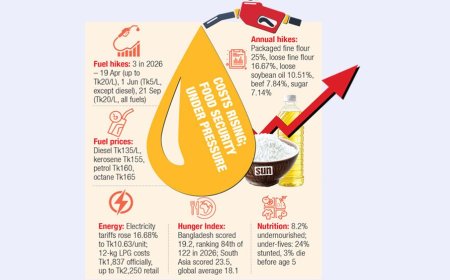
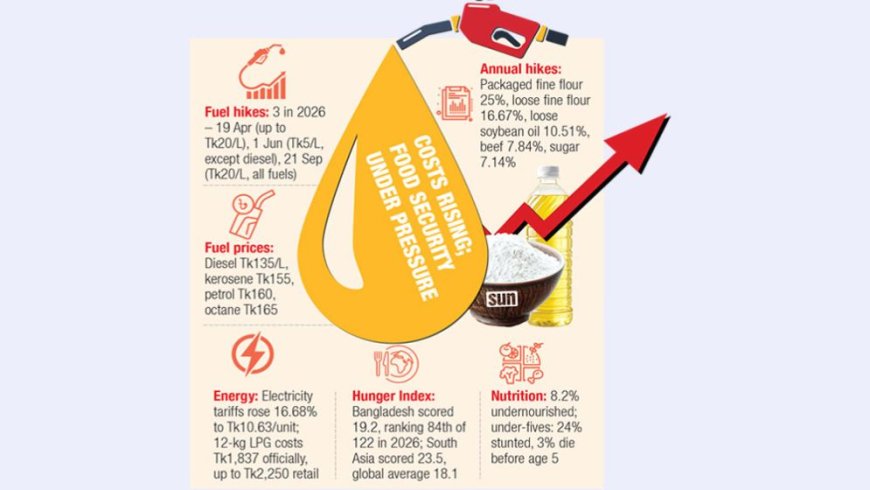
Bangladesh raised fuel prices three times in 2026 amid global market volatility linked to conflicts in the Middle East and the Russia-Ukraine war. Prices increased by up to Tk20 per litre on April 19, by Tk5 per litre for all fuels except diesel on June 1, and by Tk20 per litre across all fuel categories on September 21.
Diesel currently costs Tk135 per litre, kerosene Tk155, petrol Tk160 and octane Tk165. Retail electricity tariffs increased by 16.68% to Tk10.63 per unit in June, while the official price of a 12kg liquefied petroleum gas (LPG) cylinder reached Tk1,837. However, cylinders are selling for as much as Tk2,250 in the retail market following multiple price hikes throughout the year.
Global market instability and supply-chain disruptions have also driven up the prices of essential food items and imported goods. Combined with high inflation, rising energy costs and weakening consumer confidence, these pressures have further strained household finances, economists said.
Bangladesh's latest Global Hunger Index (GHI) score highlights the country's continuing nutritional challenges despite progress in several key indicators.
Bangladesh Remains in Moderate Hunger Category
Bangladesh scored 19.2 in the 2026 Global Hunger Index, ranking 84th among 122 countries with sufficient data and remaining in the moderate hunger category.
The index assesses hunger through four indicators: undernourishment, child wasting, child stunting and under-five mortality. In Bangladesh, 8.2% of the population is undernourished. Among children under five, 24% suffer from stunting, 12.9% from wasting, while the under-five mortality rate stands at 3%.
Bangladesh's score of 19.2 is below South Asia's regional average of 23.5 but above the global average of 18.1, indicating that hunger and undernutrition remain significant concerns.
Child stunting has declined gradually, falling from 25.4% in 2023 to 24.8% in 2024, 24.4% in 2025 and 24% in 2026. However, persistent malnutrition underscores the fact that higher food production and economic growth do not automatically guarantee adequate nutrition for every household.
Affordable Protein-Rich Food Remains Essential
Economist and researcher Dr Jahangir Alam told the Daily Sun that rising prices of eggs, milk, flour, edible oil and meat are limiting consumers' access to nutritious food, potentially affecting their health and capacity to work.
He said Bangladesh had largely overcome cereal shortages and increased the production of milk, fish, meat and eggs. However, higher prices have prevented consumption from increasing at the same pace, largely because of elevated production costs and inefficiencies.
Dr Alam stressed the importance of adopting modern technologies, encouraging innovation, improving livestock breeds, and upgrading feed quality and farm management to increase production efficiency.
He also called for reducing the influence of middlemen, marketing expenses and excessive profit margins through modernised production and distribution systems to make nutritious food more affordable.
Prices of Essential Commodities Continue to Rise
Data from the Trading Corporation of Bangladesh (TCB), as of Friday, October 16, show that prices of several essential food items have increased over both the past month and the past year.
Flour and Edible Oil
Loose white flour prices rose by 2.04% over the past month and 3.09% over the year. Packaged flour increased by 8% month-on-month and 12.50% year-on-year, while loose fine flour rose by 3.70% in a month and 16.67% in a year. Packaged fine flour recorded increases of 9.38% over the month and 25% over the year.
Edible oil prices also continued to climb. Loose soybean oil increased by 2.10% month-on-month and 10.51% year-on-year. One-litre bottled soybean oil rose by 1.24% over the month and 6.53% over the year, while two-litre bottles increased by 1.49% and 7.89%, respectively.
Five-litre bottled soybean oil prices rose by 1.27% in a month and 9.29% in a year. Loose palm oil increased by 1.48% month-on-month and 8.89% year-on-year, while loose super palm oil rose by 2.01% and 9.91%, respectively.
Five-litre bottled rice bran oil recorded increases of 3% over the month and 5.92% over the year.
Pulses, Potatoes and Spices
Chickpea prices increased by 7.14% over both the past month and the past year. Potato prices remained unchanged during the month but rose by 22.22% year-on-year.
Imported garlic prices climbed by 8.33% month-on-month and 18.18% year-on-year. Local garlic became 9.09% more expensive over the month, although its price remained unchanged compared with a year earlier.
Local onion prices increased by 4.76% over the month but fell by 29.03% year-on-year.
Imported ginger prices rose by 17.24% in a month but declined by 10.53% over the year. Green chilli prices increased by 16.67% month-on-month while remaining 33.33% lower than a year earlier. Cucumber prices rose by 7.69% over both periods.
Meat, Chicken and Eggs
Beef prices increased by 1.23% over the past month and 7.84% over the year. Mutton prices remained unchanged month-on-month but rose by 15.91% year-on-year.
Local chicken prices were unchanged during the month but increased by 12.50% compared with a year earlier. Broiler chicken prices fell by 2.63% month-on-month but remained 4.23% higher year-on-year.
Farm egg prices declined by 1.02% over the month but increased by 2.11% compared with the same period last year.
Powdered Milk and Sugar
The price of a one-kilogram pack of Dano powdered milk increased by 1.12% over the month and 13.92% over the year.
Prices of one-kilogram packs of Diploma powdered milk remained unchanged month-on-month but rose by 4.52% year-on-year. Fresh powdered milk prices were also unchanged over the month but increased by 5.81% over the year, while Marks powdered milk recorded no monthly change but rose by 5.78% year-on-year.
Sugar prices remained stable over the past month but increased by 7.14% compared with a year earlier.
The persistent rise in the cost of food, fuel and other essentials is intensifying pressure on household budgets. Economists warn that when families are forced to prioritise basic expenses over protein-rich and nutritious food, the consequences can extend beyond immediate financial hardship, affecting public health, workforce productivity and the country's long-term nutritional progress.
What's Your Reaction?