

























































Bridalwear: Bangladesh’s New Frontier for Skills Development
Bridalwear: Bangladesh’s New Frontier for Skills Development

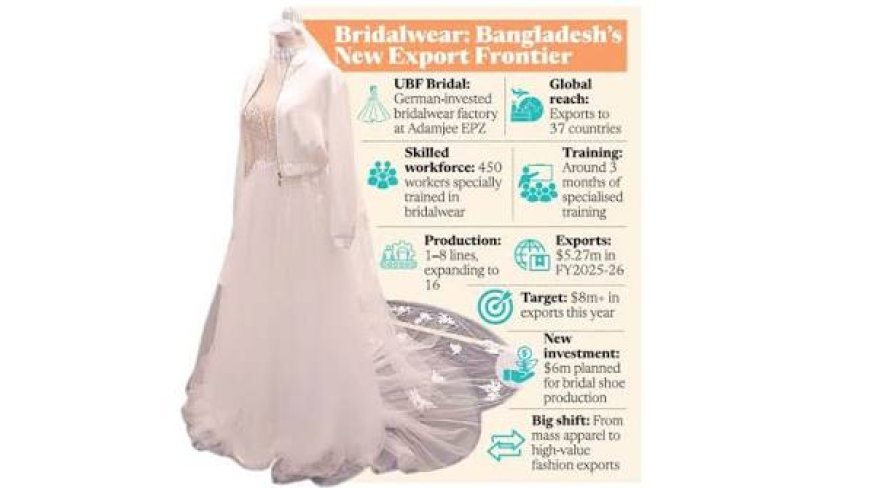
When Bedana Akhter joined UBF Bridal Ltd at Adamjee Export Processing Zone three and a half years ago, wedding gowns were an entirely unfamiliar territory.
Having previously worked in a conventional garment factory, she found herself in a very different production environment—one that demanded greater precision, delicate handling of fabrics, intricate stitching and meticulous attention to detail.
“At first, everything felt overwhelming—I didn’t know where to begin,” Bedana recalled. “My supervisors guided me step by step, teaching me how to inspect garments, attach tags and handle the complicated finishing processes. Today, I feel completely comfortable doing the work.”
Bedana is now part of a specialised workforce producing high-end bridal and evening wear for international markets and runways.
Her journey reflects a broader, quiet transformation taking place in Bangladesh’s apparel industry. Workers who were once trained mainly for high-volume, low-margin garment production are increasingly acquiring the specialised skills needed to manufacture sophisticated, design-intensive and higher-value fashion products.
Building specialised skills from the ground up
German-invested UBF Bridal began operations under the Bangladesh Export Processing Zones Authority (BEPZA) in 2022, after construction of its Adamjee EPZ factory began in 2020.
The company manufactures wedding gowns, evening dresses, wedding suits, veils, boleros, jackets, petticoats and a range of bridal accessories. Its products are exported to Germany and distributed from the group’s central warehouse in Berlin to approximately 37 countries.
Setting up the operation, however, came with a major challenge: finding workers with the specialised skills required for bridalwear production.
Bridal garments involve delicate materials such as organza and soft linings, along with intricate lace, embroidery and decorative detailing.
“There were many challenges at the beginning because we could not find workers with experience in this type of product,” said Md Robiul Hoque Siddiki, chief operating officer of UBF Bridal.
The skills gap was not limited to factory workers. The company also had to train its management team. Managers underwent roughly six months of training with support from the company’s international production team through video conferences, visiting specialists and overseas production managers.
Workers recruited from conventional garment factories subsequently received specialised training in bridalwear techniques.
The investment in training has gradually translated into higher productivity. Factory efficiency has increased from about 30% at the beginning to around 60%, with management aiming to reach 80%.
The factory started with a single production line and has since expanded to eight. The company is considering further expansion to as many as 16 lines, with roughly 23 operators assigned to each line.
“We recruit gradually, train them and then expand the number of production lines,” Siddiki said. “This allows us to develop the skills we need.”
From conventional garments to bridal fashion
New employees typically undergo about three months of training before being assigned to specific production processes.
Rather than looking exclusively for workers with previous bridalwear experience, the company recruits operators who are already familiar with conventional machines, including overlock and single-needle machines. They are then trained to adapt those skills to delicate and complex bridal garments.
“The difference between my previous job and this factory is huge,” Bedana said. “When I started here, I didn’t understand these processes. My seniors taught me step by step. Now I can do the work much better.”
The shift is significant for Bangladesh’s apparel sector.
Traditional garment manufacturing generally emphasises speed, volume and repetitive production. Bridalwear, by contrast, demands precision, craftsmanship and exceptional attention to detail.
UBF Bridal is therefore creating a specialised workforce largely from Bangladesh’s existing pool of garment workers rather than depending entirely on a new source of labour.
From Adamjee to international markets
UBF Bridal’s expansion is also reflected in its export performance.
BEPZA data show that the factory had approximately $3.66 million in actual investment and employed 357 local workers as of July 2026. It exported goods worth $5.27 million during the 2025-26 financial year.
Company officials said its workforce has since increased to around 450.
According to Siddiki, Bangladesh initially accounted for roughly 20% of the group’s total production demand. That share has now increased to about 40%.
The group also operates production facilities in Poland and the United States, but Bangladesh is emerging as its preferred location for future expansion.
“Poland and the United States are much more expensive in terms of labour costs,” Siddiki said. “Our plan is to gradually shift more production to Bangladesh.”
Such a move could generate additional investment, employment and specialised manufacturing capabilities in the country.
Towards a local supply chain
UBF Bridal is also working to develop a more localised supply chain.
The factory still imports some specialised lace, including from Myanmar, but it has begun developing an in-house embroidery section and plans to manufacture more components locally.
“Our chairman’s plan is to make each and every component ourselves, including the smallest components, and then convert them into the final product,” Siddiki said.
The company is also planning to establish a bridal shoe manufacturing facility at Adamjee EPZ, representing an additional investment of around $6 million. The facility is expected to initially employ approximately 45 workers.
The initiative could gradually transform the operation from a garment factory into a more integrated bridalwear manufacturing hub, producing both apparel and accessories.
Moving towards higher-value products
Bridalwear remains a relatively small segment compared with Bangladesh’s enormous conventional apparel industry. However, it provides access to a significantly higher-value market.
Company officials said UBF Bridal products can retail internationally for around $400 to $500, while some premium pieces sell for more than $1,000.
The average value of products currently manufactured in Bangladesh ranges from approximately $120 to $178, depending on the item.
The opportunity, therefore, is not merely to manufacture more garments but to produce garments with greater value.
For Bangladesh, whose apparel industry has traditionally depended heavily on high-volume ready-made garment exports, entering specialised and design-intensive segments could help diversify the sector and move the country further up the global apparel value chain.
Why Adamjee matters
Adamjee Export Processing Zone in Narayanganj was established in 2006 on the former site of Adamjee Jute Mills.
The 292.62-acre zone has since evolved into a major export-oriented industrial centre. BEPZA data show that it employs more than 76,000 people, has attracted approximately $847 million in investment and generated more than $11 billion in cumulative exports.
UBF Bridal brings another specialised product category to that industrial ecosystem.
The company also benefits from relatively reliable utility services within the EPZ. Its production does not depend on gas because its boilers run on electricity, helping protect the factory from some of the gas shortages experienced by industries elsewhere.
The human face of diversification
For Bedana, however, the transformation is about more than investment figures, production lines or export earnings. It is about learning a completely new craft.
She entered the factory with experience in conventional garment manufacturing but without the specialised knowledge required to produce bridalwear. Through structured training and years of hands-on experience, she has developed skills in a niche and demanding field.
“At first it was very difficult,” she said. “Now, Alhamdulillah, things are much better. My supervisors and managers have trained us and given us opportunities. We are doing well.”
Her experience highlights an important but often overlooked dimension of industrial diversification: investment alone does not create a skilled workforce.
When companies enter new manufacturing segments, they often have to develop specialised expertise themselves through training, technology transfer and gradual expansion.
That is precisely what is happening at Adamjee.
UBF Bridal entered Bangladesh with a specialised product, discovered that the required skills were scarce and began building its workforce from the ground up.
The factory has expanded from one production line to eight, with further growth under consideration.
For Bangladesh’s apparel industry, the significance lies not only in the wedding gowns and other garments being shipped to customers around the world, but also in the specialised skills being developed on the factory floor.
Bridalwear may remain a niche segment today. But the ability to produce intricate, design-intensive and higher-value fashion could become an increasingly important part of Bangladesh’s next phase of manufacturing.
What's Your Reaction?