

























Teacher vacancies are putting primary education under increasing pressure
The Education Minister recently stated that 36,235 headteacher positions remain vacant across 65,567 government primary schools.

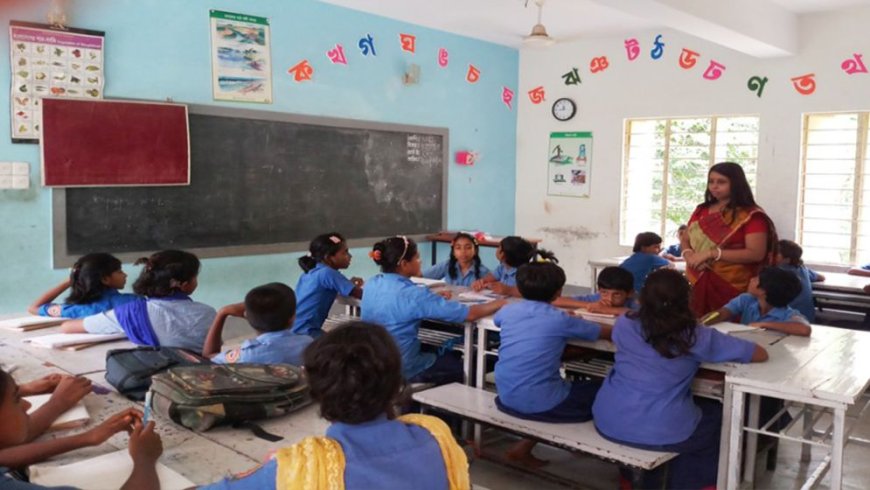
Teacher shortages are placing Bangladesh’s government primary education system under growing strain, with thousands of vacant posts forcing existing teachers to shoulder additional teaching and administrative responsibilities. The situation is disrupting classroom instruction and raising concerns over the quality of education.
The shortage means many teachers are required to handle multiple classes and subjects while also carrying out administrative duties, leaving them overburdened and reducing the time available for effective teaching.
Education Minister ANM Ehsanul Hoque Milon recently said 36,235 headteacher positions were vacant across the country’s 65,567 government primary schools.
The government says a long-standing legal dispute surrounding headteacher appointments has now been resolved, paving the way for recruitment to begin soon. Authorities also say the shortage of assistant teachers has been largely addressed, with more than 14,000 newly recruited teachers expected to join schools after completing their training.
The scale of the problem is evident at West Nangla Government Primary School in Madarganj upazila of Jamalpur, where five teaching positions are sanctioned but only one teacher has been working since January 15.
Headteacher Abdul Momin is currently running the entire school alone, teaching 70 students while also managing administrative responsibilities.
A similar situation exists at North Rasulpur Government Primary School in Cumilla Sadar upazila, where the headteacher position has remained vacant for nearly a decade.
Assistant teacher Mohammad Manjurul Alam has been performing the duties of headteacher alongside teaching 225 students and managing administrative, financial and official tasks.
Officials from the Directorate of Primary Education (DPE) said many schools have gone years without headteachers because of legal complications related to recruitment, seniority and promotion.
Under existing regulations, 20 percent of headteacher positions are filled through direct recruitment, while the remaining 80 percent are filled through promotion from among assistant teachers.
A writ petition filed in 2017 challenged a provision of the 2013 Recruitment Rules related to seniority, effectively delaying the process of filling a large number of vacant positions.
Officials at the Ministry of Primary and Mass Education said a formal requisition would soon be sent to the Public Service Commission to initiate direct recruitment and promotions under special arrangements.
In October last year, then-DPE Director General Abu Noor Md Shamsuzzaman said around 13,500 assistant-teacher positions were vacant nationwide.
The shortage is also affecting schools such as Sonarua Government Primary School in Kapasia upazila of Gazipur, where only four teachers are working against six sanctioned posts.
Acting headteacher Ashraful Islam said about three classes have to be cancelled every day because of the shortage of teachers.
State Minister Bobby Hajjaj said the assistant-teacher shortage had been reduced significantly, with only around 2,000 more teachers now needed.
The 14,000 newly recruited teachers are currently undergoing police verification and will receive two months of training before joining schools.
Around 387,000 teachers are currently serving in government primary schools across Bangladesh.
The DPE’s Annual Sector Performance Report 2024 found that 12,935 government primary schools were operating with four or fewer teachers. Among them, 133 schools had only one teacher, while 633 had just two.
The report warned that severely understaffed schools with limited human resources face serious challenges in maintaining classroom instructional quality and managing multi-grade teaching.
According to 2023 data cited in the report, government primary schools had an average of 6.29 teachers each. Chattogram recorded the highest average at 6.65, followed by Dhaka at 6.52 and Rajshahi at 6.46. Sylhet had the lowest average at 5.59, followed by Barishal at 5.89.
Rasheda K Choudhury, executive director of the Campaign for Popular Education (CAMPE), said the teacher shortage has persisted for years and worsened in some areas following the Covid-19 pandemic.
She said weaker students are particularly affected because understaffed schools have limited capacity to provide remedial support.
Delays in recruitment, difficulties in attracting qualified teachers and reluctance among some teachers to work in remote areas have all contributed to the persistent shortage, she added.
What's Your Reaction?