





























































Shifting Global Grain Markets Pose Threat to Bangladesh’s Food Security
Shifting Global Grain Markets Pose Threat to Bangladesh’s Food Security

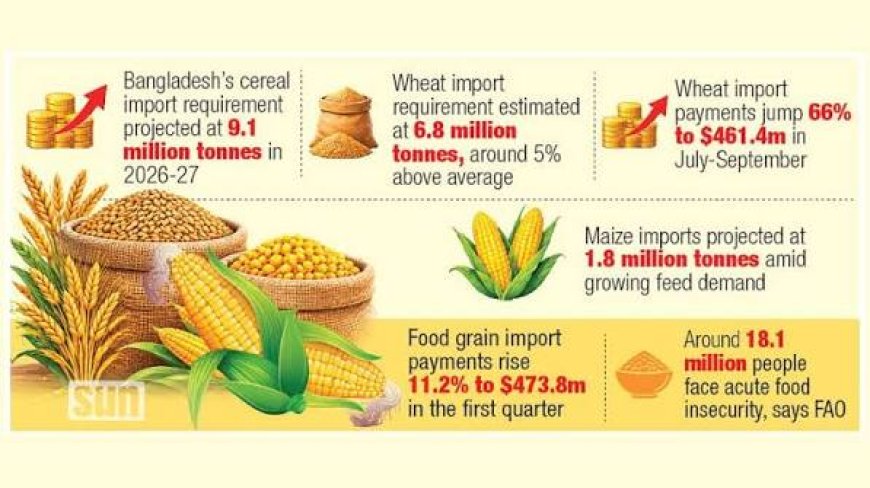
Bangladesh’s heavy dependence on imported wheat and maize exposes its food supply chain to volatility in global grain markets, while rising demand from food processing, livestock feed and industrial sectors continues to increase import requirements.
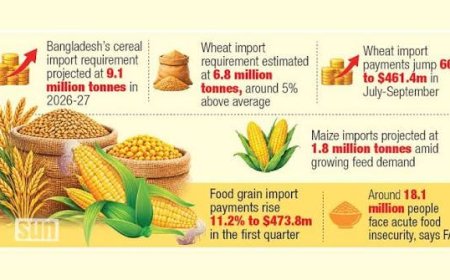
The country is projected to need 9.1 million tonnes of imported cereals in the 2026-27 marketing year, comprising 6.8 million tonnes of wheat and 1.8 million tonnes of maize, according to the Food and Agriculture Organization (FAO).
Economist and researcher Dr Jahangir Alam Khan told the Daily Sun that Bangladesh’s food security would increasingly hinge on its ability to strike a balance between domestic agricultural production and dependable, affordable access to international grain markets.
He stressed the importance of improving agricultural productivity, expanding public grain storage capacity, diversifying import sources and ensuring timely procurement to strengthen the country's food security.
He also pointed out that the rapid growth of the processed-food, poultry, livestock and aquaculture industries was fuelling demand for wheat and maize.
Wheat imports account for a significant share
Bangladesh’s domestic wheat production remains inadequate to meet national consumption requirements, making imports essential for supplying households, flour mills, bakeries and food-processing industries, Dr Jahangir Alam Khan said.
The FAO has projected Bangladesh’s wheat import requirement at 6.8 million tonnes for the 2026-27 marketing year, approximately 5% higher than the average.
Bangladesh Bank data indicate that wheat import payments reached $461.4 million during July-September of fiscal year (FY) 2026-27, marking a 66% increase from $277.9 million recorded during the corresponding period of FY2025-26.
Rice production remains strong as imports decline
Bangladesh’s total paddy production is estimated at 61.9 million tonnes in 2026, approximately 5% above the average, according to the FAO.
The 2026 Boro harvest is projected at 31.9 million tonnes, while Aus production is estimated at 4.1 million tonnes.
However, flooding and landslides between May and July resulted in localised crop losses across several districts in the southeastern and northeastern regions, the FAO reported. At the time of the organisation’s September country brief, the Aman crop was still in its vegetative growth stage.
Meanwhile, Bangladesh’s rice import expenditure dropped sharply to $12.4 million during July-September of FY2026-27, compared with $148.2 million in the same period of the previous fiscal year, according to Bangladesh Bank data.
Rising feed demand drives maize imports
Growing consumption requirements from the poultry, livestock and aquaculture industries are contributing to increased maize imports, according to the US Department of Agriculture (USDA).
USDA estimates indicate that Bangladesh’s domestic maize production will reach approximately 6 million tonnes in the 2026-27 marketing year, while imports are projected at around 1.8 million tonnes.
Brazil remains the leading supplier of imported maize to Bangladesh, with India and the United States also contributing to the country's import supply.
Food grain import expenditure increases
Bangladesh spent $473.8 million on food grain imports during July-September of FY2026-27, compared with $426.1 million in the corresponding period of FY2025-26, representing an 11.2% year-on-year increase, Bangladesh Bank data show.
Millions face acute food insecurity
Approximately 18.1 million people in Bangladesh are expected to experience high levels of acute food insecurity between September and December 2026, according to the FAO’s September 2026 country brief.
The organisation attributed the worsening situation to declining household purchasing power amid persistently high inflation, rising fuel and energy costs, and the adverse effects of flooding on livelihoods.
What's Your Reaction?