
























































Government still subsidising diesel by Tk70 per litre despite price hike
Government still subsidising diesel by Tk70 per litre despite price hike

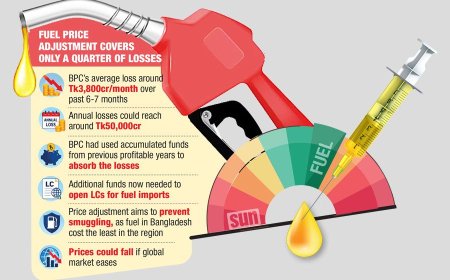
Diesel is still being sold at around Tk70 a litre below its procurement cost despite the government’s Tk20 fuel price hike, leaving the Bangladesh Petroleum Corporation (BPC) facing mounting losses amid soaring international prices.
BPC Chairman Dr Md Rafiqul Islam said the corporation was purchasing diesel at about Tk205 a litre but selling it at Tk135 under the revised pricing structure.
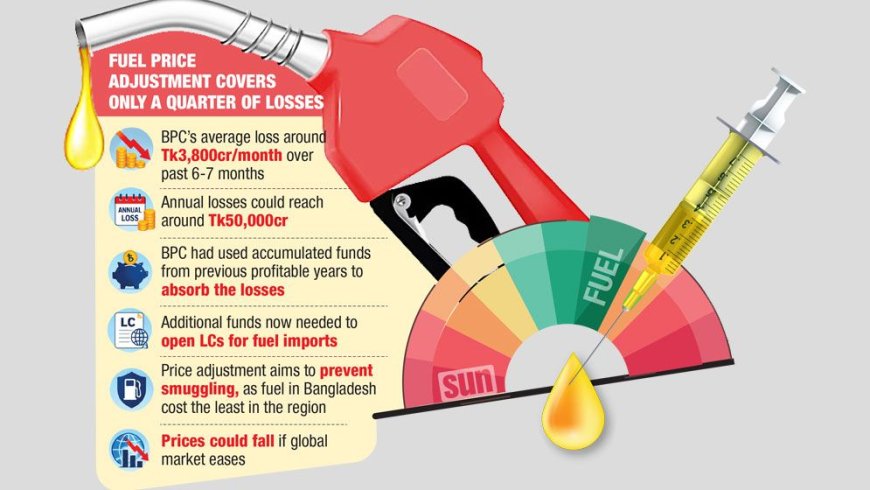
“Roughly, we buy diesel at Tk205 and sell it at Tk115. So, there was a loss of around Tk90 per litre,” Rafiqul Islam told the Daily Sun, adding that the latest price adjustment would cover only about one-fourth of the losses.
He said BPC had been incurring average monthly losses of around Tk3,800 crore over the past six to seven months. If the trend continued, annual losses could reach nearly Tk50,000 crore, he warned.
Diesel accounts for around 65% of BPC’s total petroleum sales, making its price a major determinant of the corporation’s financial position.
Under the new pricing structure, diesel is priced at Tk135 a litre, while kerosene, petrol and octane cost Tk155, Tk160 and Tk165 respectively.
BPC seeks government financial support
Rafiqul Islam said BPC had previously relied on accumulated reserves from profitable years to absorb losses and avoid raising fuel prices. However, the corporation now needs additional funds to finance fuel imports and open letters of credit (LCs).
He said BPC would require around Tk1,500 crore to meet fuel-import financing needs through October, followed by another Tk12,500 crore for purchases approved by its procurement committee through December.
BPC is seeking a special financial arrangement from the government to bridge the funding gap.
The chairman said BPC had not received any direct subsidy over the past six months and had instead absorbed the losses from its accumulated reserves. However, the government has arranged around Tk5,000 crore to help the corporation meet its immediate financing needs, he said.
According to Rafiqul Islam, BPC had generally remained profitable in recent years before the current crisis. The corporation last suffered major losses in 2013-14, while profits generated in subsequent years were retained for development projects and other requirements.
Those accumulated funds were subsequently used to absorb losses caused by the sharp rise in international fuel prices. With losses continuing, however, BPC’s financial reserves are coming under growing pressure.
Rising import costs deepen losses
The increase in international fuel prices has been the primary driver of BPC’s losses, the chairman said. Higher freight rates, insurance costs and longer shipping times have further increased procurement expenses.
Some shipments that previously took around 15 days to arrive are now taking as long as 50 days, he said.
BPC imports petroleum under government-to-government (G2G) arrangements with several countries as well as through open tenders. The corporation currently has G2G supply arrangements with around eight to nine countries, while tender-based procurement is also continuing.
Bangladesh had among the lowest fuel prices
State Minister for Power, Energy and Mineral Resources Anindya Islam Amit said the government had little choice but to increase fuel prices because of higher international prices, freight charges and insurance costs.
He apologised to consumers for the hardship caused by the increase, saying the government had delayed the decision as long as possible.
The latest price adjustment is expected to reduce BPC’s annual losses by around Tk10,000 crore, he said.
Amit said Bangladesh’s fuel prices had been among the lowest in the region compared with neighbouring and other Asian countries.
According to figures provided by him, diesel costs Tk134.76 a litre in Kolkata, Tk164.83 in Myanmar, Tk161.24 in Nepal, Tk179.42 in Sri Lanka, Tk151.22 in Thailand, Tk137 in Vietnam, Tk140 in the Maldives, Tk168.53 in the Philippines, Tk185.48 in Pakistan and Tk144.79 in the United Arab Emirates.
“Among the countries in this region, our beloved motherland Bangladesh had the lowest fuel prices,” he said, adding that relatively low domestic prices had created a significant risk of fuel smuggling to neighbouring countries.
He said the government had to adjust prices both to discourage smuggling and to continue funding social protection programmes.
Asked whether there was information about fuel being smuggled across the border, Amit said various responsible sources had indicated such a risk and that the government had based its decision on those assessments.
He noted that diesel costs Tk134.76 a litre in Kolkata, while BPC is still effectively absorbing a gap of around Tk70 per litre on diesel sold domestically.
The government therefore sought to bring domestic prices closer to those in neighbouring countries to reduce the incentive for smuggling, he said.
Prices may fall if global market eases
BPC Chairman Rafiqul Islam said the corporation could benefit if international fuel prices decline in the coming months.
He said the latest price adjustment was intended to provide BPC with some financial cushion and prevent its development activities and projects from being disrupted by continuing losses.
The energy minister also said fuel prices would be reduced if international markets stabilise. He expressed hope that the Middle East crisis would ease soon, allowing fuel prices to return to previous levels or fall further.
Expert calls for market monitoring
Energy expert Prof Dr Ijaz Hossain said the government had been compelled to raise fuel prices because of the sharp increase in international oil prices.
He said consumers would need to reduce fuel consumption to cope with the situation, but domestic prices should also be lowered once international markets return to normal.
Prof Ijaz also warned that the fuel price increase should not become a pretext for unjustified increases in the prices of other goods.
“The government should monitor the market effectively so that consumers are not placed under additional pressure,” he said.
What's Your Reaction?