














































Business leaders anticipate $1 billion in FDI in the near term, targeting a 10% share of Japan’s RMG market by 2035
Business leaders anticipate $1 billion in FDI in the near term, targeting a 10% share of Japan’s RMG market by 2035.

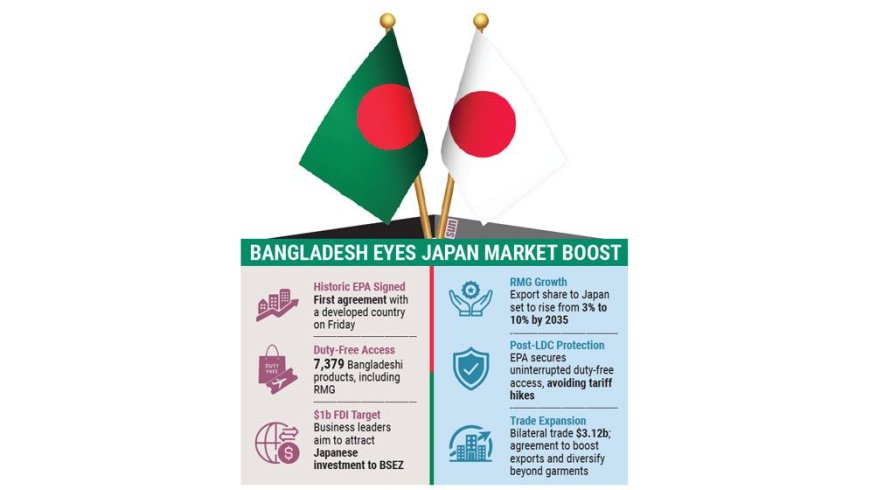
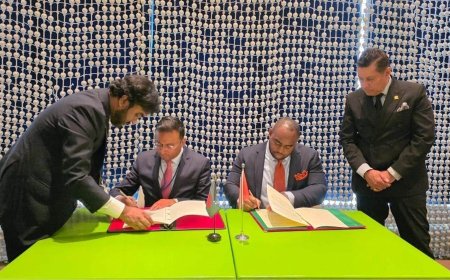
Bangladesh has entered a new phase of trade diplomacy by signing its first comprehensive economic agreement with a developed nation. On February 6, 2026, Bangladesh and Japan signed the Economic Partnership Agreement (EPA) in Tokyo.
The agreement was signed by Japan’s State Minister for Foreign Affairs Horii Iwao and Bangladesh’s Commerce Adviser Sk Bashir Uddin. Economists and business leaders have hailed the EPA as a landmark development that will help Bangladesh navigate the post-LDC transition.
The EPA is expected to expand bilateral trade, attract greater foreign investment, and strengthen cooperation in technology, supply chains and industrial development. Under the agreement, Japan will grant 100 percent duty-free access to 7,379 Bangladeshi products, including ready-made garments (RMG). In return, Bangladesh will offer duty-free or preferential access to 1,039 Japanese products, easing imports of technology-intensive goods and industrial inputs.
Currently, Bangladesh exports garments worth about $1.41 billion to Japan—around 3 percent of its total apparel exports—despite Japan being the world’s second-largest garment importer after the United States. With Bangladesh aiming for $100 billion in garment exports by 2035, industry leaders want to increase Japan’s share to at least 10 percent.
Calls for more trade agreements with developed economies
Speaking to Daily Sun, former president of the Japan Chamber of Commerce and Industry in Bangladesh (JBCCI) Asif A Chowdhury said the EPA would be mutually beneficial, particularly as Bangladesh prepares to lose duty-free market access following LDC graduation.
“Without the EPA, Bangladesh would lose preferential access to the Japanese market in the post-LDC period. This agreement secures continued duty-free access,” he said.
Asif, who is also CEO and managing director of Chowdhury Group, said the EPA would stimulate exports and attract investment, especially in the Bangladesh Special Economic Zone—also known as the Japanese Economic Zone—in Araihazar, Narayanganj.
“We hope Japanese investors will invest around $1 billion in the Japanese Economic Zone in the near future,” he added.
He urged the government to accelerate negotiations on EPAs, FTAs and similar trade arrangements with other developed countries, noting that Bangladesh’s competitors are moving ahead with new trade deals. He also stressed the importance of prioritising agreements with the European Union, pointing out that India has already finalised an FTA with the bloc. “Securing GSP Plus should be Bangladesh’s top priority,” he said.
Positive signal for future FTAs
Chairman of Policy Exchange Bangladesh (PEB) Dr Masrur Reaz said the EPA with Japan—one of the world’s leading economies—would encourage other countries to pursue similar agreements with Bangladesh.
“Any EPA or free trade agreement helps boost trade and investment,” he said, adding that the deal would help offset the loss of trade preferences after LDC graduation.
He also emphasised the need for domestic policy reforms, improved logistics and stronger trade facilitation to attract larger volumes of Japanese investment.
BGMEA hails EPA as historic milestone
The Bangladesh Garment Manufacturers and Exporters Association (BGMEA) described the Japan-Bangladesh EPA as a historic milestone in the country’s trade diplomacy.
In a statement signed by acting secretary Major (Retd) Md Saiful Islam, BGMEA also termed the upcoming US-Bangladesh trade talks scheduled for February 9 in Washington, DC, as another significant development.
BGMEA said the EPA follows seven rounds of negotiations covering trade in goods and services and reflects a shared commitment to deepen economic engagement. The agreement is expected to substantially improve market access for Bangladeshi exports, particularly RMG products, which dominate shipments to Japan.
At present, Bangladesh enjoys duty-free access to Japan under the GSP scheme. However, after LDC graduation, Bangladeshi garments would otherwise face MFN tariffs ranging from 8 to 15 percent for knitwear and 10 to over 15 percent for woven items.
Under the EPA, customs duties on garment products will be fully eliminated from the date the agreement enters into force. BGMEA also welcomed Japan’s flexibility on rules of origin, noting that garments produced under single-stage processing will qualify for duty-free access—among the most favourable arrangements globally.
The association said the EPA creates a predictable trade environment and called for a clear national roadmap to maximise its benefits in line with the $100 billion garment export target. Bangladesh currently runs a trade deficit of about $456 million with Japan, and BGMEA believes the EPA will help narrow the gap while encouraging export diversification and deeper engagement from Japanese buyers, machinery suppliers and long-term investors.
Untapped trade potential
According to Bangladesh Bank and Export Promotion Bureau (EPB) data, bilateral trade between Bangladesh and Japan stood at $3.12 billion in FY24, with exports at $1.31 billion and imports at $1.81 billion. Bilateral trade was higher at $3.93 billion in FY23.
Bangladesh received $47.84 million in Japanese foreign direct investment in FY24. Between 2001 and March 2025, cumulative Japanese FDI reached $507.14 million, accounting for 2.7 percent of total FDI inflows.
Bangladesh mainly exports T-shirts, jerseys, pullovers and handbags to Japan, while imports include vehicles, aircraft and transport equipment, machinery, electrical goods and audio-visual equipment.
What's Your Reaction?