

























































CPD recommends Tk24,000 minimum monthly wage for RMG workers
RMG minimum wage should be determined through calculations, not negotiations, says think tank

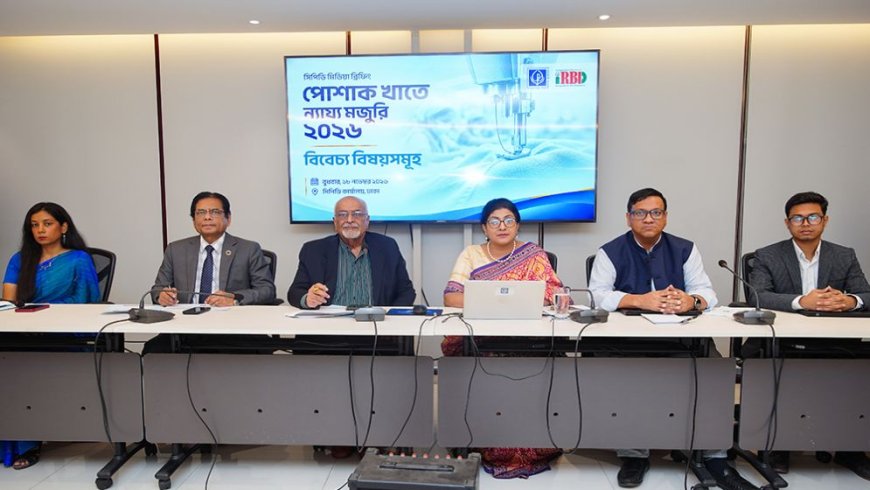
The Centre for Policy Dialogue (CPD) on Wednesday recommended setting the new minimum monthly wage for garment workers within a range of Tk18,578 to Tk24,204, urging the Minimum Wage Board to rely on evidence rather than pressure-driven negotiations.
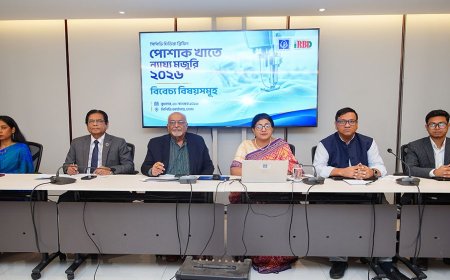
CPD Executive Director Nazneen Ahmed presented the findings of a study titled "Determining the Minimum Wage in the RMG Sector" at the think tank's Dhanmondi office. The study found that the wage board is operating without an independent, up-to-date and comprehensive evidence base.
"There is no survey of workers and no assessment of the industry," Nazneen said, adding that there is also no agreed methodology or set of indicators for calculating wages.
"Wage determination should not be a matter of pressure-induced bargaining," she said, describing the existing process as a "quick fix" in which wages are negotiated rather than calculated.
Using available secondary data, CPD estimated the appropriate wage through three different approaches.
First, adjusting the entry-level wage of Tk12,500, introduced in December 2023, for a 30.8% increase in urban prices brings the figure to Tk16,351.
However, this adjustment merely restores the purchasing power of Tk12,500 as it stood in November 2023, without providing any real increase in wages, the study noted.
The second estimate, based on Dhaka's upper urban poverty line, suggests that a monthly income of Tk18,578 per earner is required to keep a four-member household above the poverty threshold.
The third estimate, calculated using a living-wage approach that covers food, essential expenses, housing and a small emergency reserve, puts the required monthly wage at Tk24,204 per earner.
All three estimates assume a four-member household with an average of 1.58 income earners.
CPD cautioned that the figures are indicative rather than definitive, as no large-scale, representative survey of RMG workers is available. The estimates are also sensitive to assumptions about household size and the number of income earners.
Existing studies put average household size between 3.6 and 4.2 members, while the number of earners per household ranges from 1.37 to 2.1.
"Basic needs set the floor, capacity to pay the ceiling; bargain within that range," the study recommended.
The presentation comes as the six-member Minimum Wage Board, formed on November 1, has yet to reach a decision on the new wage.
Workers' representatives proposed a minimum monthly wage of Tk32,000 for entry-level workers on November 9, while factory owners have yet to submit their proposal.
The board's third meeting, originally scheduled for November 16, has been postponed until November 23. The revised wage is scheduled to take effect from December 1 and be reflected in workers' January 2027 salaries.
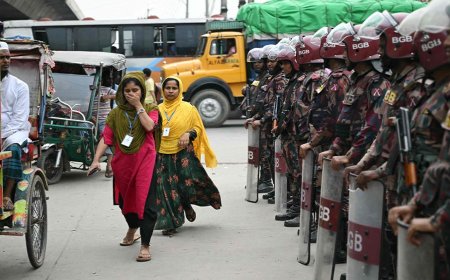
Garment workers have been demanding a minimum monthly wage of Tk30,000 since protests began in October. Factory owners, meanwhile, have warned of closures under a "no work, no pay" policy if unrest continues.
CPD also highlighted a recurring pattern of violence during wage negotiations, noting that unrest has accompanied every minimum wage revision between 2006 and 2026.
During consultations held with CPD on November 11 and 12, factory owners cited rising gas, energy and borrowing costs, along with declining export prices, as major constraints on their ability to absorb higher wages. They also expressed concerns that international buyers would be unwilling to share the additional costs.
Workers, on the other hand, demanded wages sufficient to cover food, housing, healthcare and education expenses. They also expressed doubts over whether the wage board would be constituted on time.
According to CPD, both workers and employers supported introducing an annual, formula-based wage adjustment mechanism.
Seven-point roadmap for wage reform
CPD proposed a seven-point roadmap to make the wage-setting process more transparent, predictable and evidence-based.
It recommended establishing the Minimum Wage Board at least six months before each wage revision. Under this proposal, the board for the December 2029 revision should be formed by June 2029.
The think tank also called for incorporating a fixed wage-review cycle into law and establishing a permanent wage commission to review workers' pay annually.
According to the study, starting the process earlier could have significantly reduced this year's unrest.
CPD further recommended defining clear indicators and data sources for the 11 factors outlined in Section 141 of the Bangladesh Labour Act 2006, which it said remain undefined even after two decades.
Other proposals include introducing a dedicated RMG module in the Household Income and Expenditure Survey (HIES), developing an RMG wage index, involving international buyers in wage discussions, publishing anonymised survey data and conducting regular wage audits through the Department of Inspection for Factories and Establishments (DIFE).
CPD also warned that ensuring a living wage is increasingly becoming a market-access requirement for Bangladesh's garment industry.
From 2029, major European Union buyers will be required to assess whether their supply chains provide an "adequate living wage". Continued duty-free access under the EU's GSP+ scheme after 2032 will also depend on compliance with labour standards.
The study stressed that determining an appropriate minimum wage alone would not be sufficient, emphasising that effective enforcement is equally important.
"A wage that is not paid achieves nothing," it said.
What's Your Reaction?